
Colour Rendering
Publish:osirlight admin Time:2021-10-12 hits:1446次
Colour Rendering Index (CRI)
Since 1931, when the first system of measuring colour rendering was formalised by the CIE (Commission Internationale de l’Eclairage = International Commission on Illumination), the lighting industry has been able to communicate the quality of its light to specifiers and end users alike.
The Colour Rendering Index (CRI or Ra) is a quantitative measure, which rates a light source’s ability to reproduce the colours of objects faithfully. In order to objectively compare the colour rendering properties of any light source, the CIE’s standardised measuring method operates on a scale from 0 to 100 (poor to excellent). The colour change of 14 standard colours is calculated when an object is exposed to a specific light source and then this is compared to a reference illuminant of the same colour temperature (a black body* is used for colour temperatures up to 5000K and daylight above that). The CRI for a pair of light sources can only be compared if they have the same colour temperature.
The CRI scale is chosen so that an ideal black body source, such as incandescent or halogen lamps, is by definition a CRI rating of 100. For light sources emitting a discrete spectrum, like LED and discharge lamps, the CRI can be anywhere between 0 - 100. As a rule of thumb, the more the spectrum is filled at all wavelengths (380 – 760nm), the better the colour rendering properties of the source, however a high CRI measurement intrinsically means lower efficacy (as less efficient wavelengths are also represented in the spectrum).
* A black body is a theoretical object that absorbs all incident electromagnetic radiation and due to its ability to absorb at all wavelengths, is the best possible emitter of thermal radiation. It radiates a continuous spectrum that depends on the body's temperature.

TM-30 Basics
TM-30 defines a new method of evaluating light source colour rendition published by the Illuminating Engineering Society of North America (IES) in 2015.
It compromises three primary components:
Rf – a fidelity index that is similar to the commonly used CRI
Rg – a gamut index that provides information about saturation
Colour vector graphic – a graphical representation of hue and saturation relative to a reference source
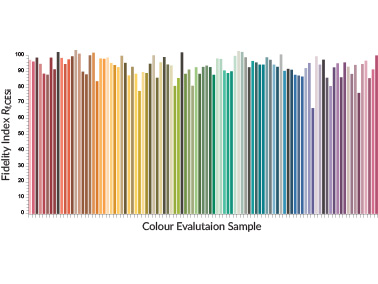
Fidelity Index (Rf):
The average of the colour difference between the test and reference conditions. This is similar to the CRI but over 99 colour samples. The Rf values range from 0 to 100, with 100 indicating an exact match with the reference.
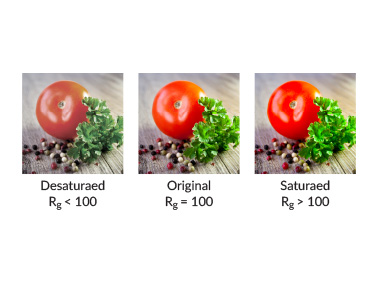
Gamut Index (Rg):
Measures relative gamut (area endorsed by the chromaticity of a set of 16 colour samples) and provides information about saturation. A score >100 means increased average saturation compared to the reference source, and a score <100 indicates decrease average saturation.
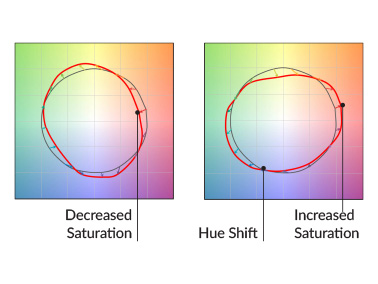
Colour Vector Graphic
A visual representation of hue and chroma shifts for all colours. This graph conveys what types of colour are more or less saturated under the tested light source relative to the reference illuminant. It also shows where hue shifts occur.
T: (+86) 0755-36630155
M: (+86) 18566251685
AD: Number 7 Dequan Street Tongle Road, Dongsheng Town Zhongshan City, Guandong,China.